Updated 4 November 2026, after the seventh straw poll and Türkiye’s nomination of Feridun Sinirlioğlu. The updates of 25 and 18 October and the original analysis of 21 September follow below.
While the world watches kinetic conflict, energy supplies, routes and straits, another decision is being taken quietly: who will lead the United Nations. The next Secretary-General will need the stamina, the character and the wisdom to steer the world’s most important multilateral body through a rough global environment.
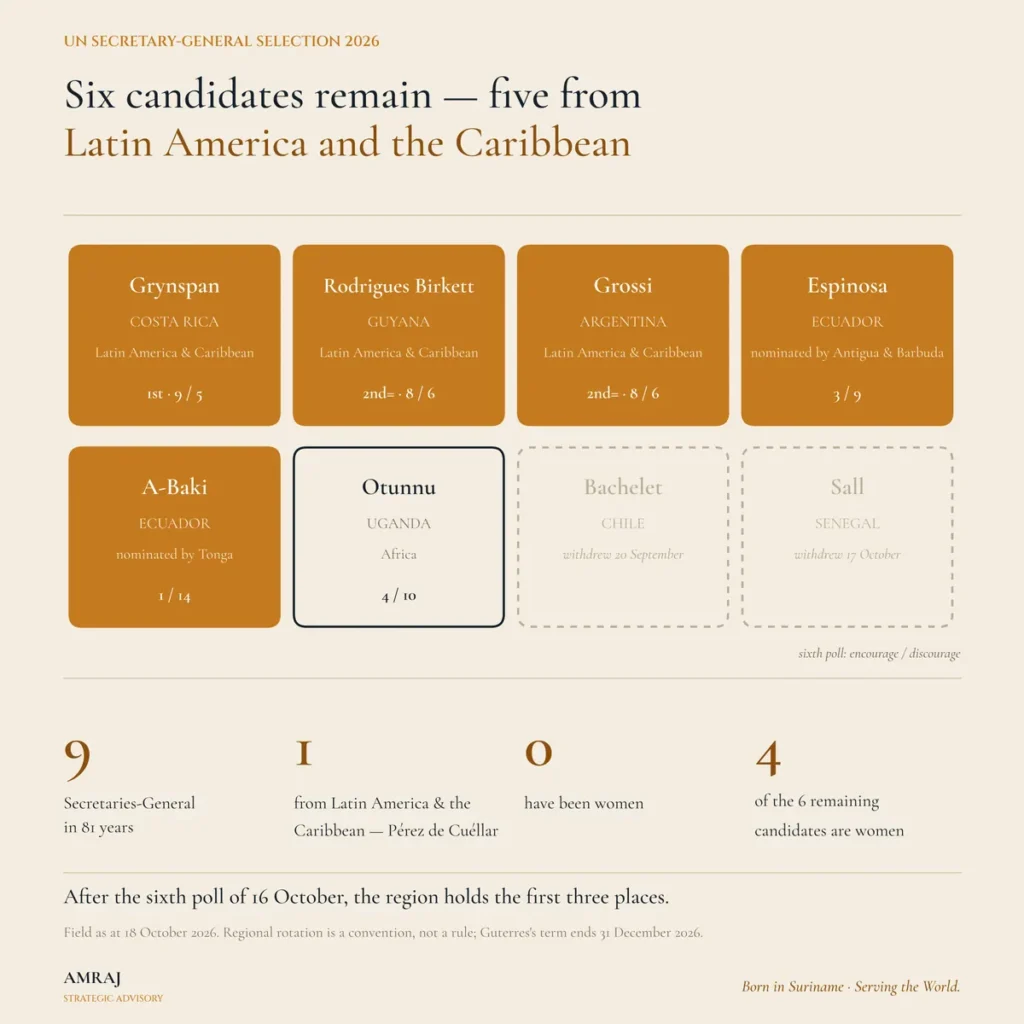
Eighty-one years. Nine Secretaries-General. Not one a woman; only one — Javier Pérez de Cuéllar of Peru — from Latin America and the Caribbean. Both may change this year: five of the eight candidates now in the race come from our region, and five are women.
4 November: Ankara enters the room
On 30 October the Security Council held its seventh straw poll. It produced what the six before it had produced: a front-runner, but no Secretary-General. Within hours, Türkiye formally nominated Feridun Sinirlioğlu, Secretary General of the OSCE, Foreign Minister in 2015 and Türkiye’s Permanent Representative in New York from 2016 to 2023. The rumour of 25 October has become a candidacy. The nomination letter, signed by President Erdoğan, was transmitted by Ambassador Ahmet Yıldız to the Presidents of the General Assembly and the Security Council. Eight candidates are now in the race.
The following day, Foreign Minister Hakan Fidan put the move on the record: Türkiye, he said, respects the expectation that Latin America should have the opportunity to produce the next Secretary-General, but the process has reached a stalemate, and the nomination is meant as “a diplomatic contribution aimed at overcoming the impasse.” He added that cross-regional entries in a deadlocked race are not without precedent. That is correct — 1981 is the precedent, and it is the one this page recalled on 25 October.
The seventh poll, as reported
The Council publishes nothing; what follows is leaked, though carried by several outlets (Reuters, Xinhua, Jewish Insider):
- Rebeca Grynspan (Costa Rica): 11 encourage, 4 discourage — her strongest result so far
- Rafael Grossi (Argentina): 9 encourage, 4 discourage, 2 no opinion
- Carolyn Rodrigues-Birkett (Guyana): 8 encourage, 6 discourage, 1 no opinion
- Lana Nusseibeh (UAE): 7 encourage, 6 discourage, 2 no opinion
Two caveats matter more than the numbers. First, this was a white-ballot round: permanent and elected members voted on identical paper, so we cannot tell whether Grynspan’s four discourage votes include a veto. Second, the UAE’s late entrant, who came in on the expectation that she could carry all five permanent members, did not disturb the leading trio. As Mariea Sekijima of the International Crisis Group put it to The National, she “may have a longer road ahead than anticipated.”
For readers in our region, the Guyanese line deserves attention: Rodrigues-Birkett holds her eight, but her discourage column has grown. The CARICOM candidacy is still alive. It is no longer ascending.
How the Turkish candidacy is being read
- As a compromise candidate — Ankara’s own framing, via Fidan and the state agency Anadolu.
- As anything but a compromise — Ben Cohen of the Foundation for Defense of Democracies (The National, 3 November) points to resistance from Greece, Cyprus, Israel, much of the EU and several Middle Eastern states. He nonetheless judges a US veto “far from certain”, given President Trump’s cultivation of President Erdoğan, and suggests that Russia, having worked with Sinirlioğlu at the OSCE, could come to favour him. China, in his reading, is harder to call.
- As a matter of timing — Richard Gowan (International Crisis Group) observes that, like Nusseibeh, Sinirlioğlu waited until the Latin American candidates began to lose steam, knowing that an earlier entry would have looked like pre-empting the region.
- As a win even in defeat — Gönül Tol (Middle East Institute) argues that the bid raises Ankara’s diplomatic profile whatever its outcome.
- As a contradiction — Cyprus, on the record through government spokesman Konstantinos Letymbiotis, calls the candidacy a “political contradiction” in view of Türkiye’s presence in northern Cyprus. Greece, an elected Council member and October’s Council President, has not yet issued a formal position.
There is a quiet irony here. President Erdoğan’s long-standing refrain is that “the world is bigger than five.” His candidate can now succeed only by passing through the five.
What is confirmed — and what is not
The selection process is, by design, half-lit: ballots are shredded, results are leaked, and positions are signalled rather than declared. Readers should weigh the following accordingly.
| Claim | Status |
|---|---|
| Türkiye formally nominated Sinirlioğlu (letter dated 30 October) | Confirmed. On the record (Fidan, Ambassador Yıldız); reported by Anadolu, AFP, AP and dpa. |
| Seventh-poll figures (Grynspan 11–4, etc.) | Leaked; not officially confirmable. Several outlets agree, but likely draw on the same leak; at least one tracker reports a different discourage count for Grynspan. |
| Sinirlioğlu floated his candidacy during High-Level Week in September | Anonymous sourcing (AP, “two diplomats briefed on the matter”); since borne out by the nomination. |
| Cyprus opposes the candidacy | Confirmed — on-the-record government spokesman. |
| Greece will oppose; Israel is pressing Washington to block | Not confirmed. Analyst expectation and unnamed “international media reports”; no official statement from Athens yet. |
| Russia may delay the eighth poll into early December, during Latvia’s Council presidency | Single source, unconfirmed. One Greek outlet (credited to AMNA), unnamed and hedged. |
| Positions of the P5 on Sinirlioğlu | Unknown. Only analyst inference; no permanent member has spoken. |
What to watch
- The next colour-coded poll. Only a red-ballot round will show whether Grynspan’s lead survives the veto test, and where Sinirlioğlu and Nusseibeh truly stand with the five.
- The calendar. António Guterres’s term ends on 31 December. If the Council cannot agree, a caretaker arrangement becomes a real, if unwelcome, option.
- The convention itself. Two out-of-region entrants in ten days is a signal. The rotation is a custom, not a rule of the Charter, and the United States has said openly that it prefers merit to rotation or gender. Whether Latin America and the Caribbean hold their turn may depend less on the merits of their candidates than on whether the region speaks with one voice in the weeks ahead.
Conventions at the United Nations are rarely abolished. They are simply stepped around, quietly, once enough members have concluded that no one will object loudly enough.
25 October: a late entrant, and the Kaag question
On 21 October the United Arab Emirates formally nominated Lana Nusseibeh, its Minister of State for Foreign Affairs and UN ambassador from 2013 to 2024. Her pitch: “speaking frankly with every government and answering to none.” The seventh straw poll, expected on 23 October, was postponed to allow her nomination to be lodged; no new date has been set. Turkey’s Feridun Sinirlioğlu, Secretary-General of the OSCE, is rumoured as a further possible entrant. Seven candidates are now in the race: Grynspan, Rodrigues-Birkett, Grossi, Otunnu, Espinosa, A-Baki and Nusseibeh.
There is no deadline for nominations. As Brett Schaefer of the American Enterprise Institute put it after the colour-coded poll, “the race just restarted.” History favours the late entrant: in 1981, after weeks of deadlock between Kurt Waldheim and Salim Ahmed Salim, the Council settled on Javier Pérez de Cuéllar — a name that was not on the ballot when the voting began. Nusseibeh’s candidacy cuts directly across the expectation that it is Latin America and the Caribbean’s turn. For our region, the task of keeping its claim united has become more urgent, not less.
And Sigrid Kaag? Her name has appeared in European press lists of names in circulation (Le Temps, republished by Geneva Solutions). On VPRO’s Zomergasten this summer she recalled that the United States had asked her to stand some ten years ago, and that the Netherlands let it lapse — “ik leef niet voor functies.” But there is no reported nomination, nor any public sign of a Dutch initiative in the current race. A name mentioned is not yet a candidacy.
18 October: the sixth straw poll and Sall’s withdrawal
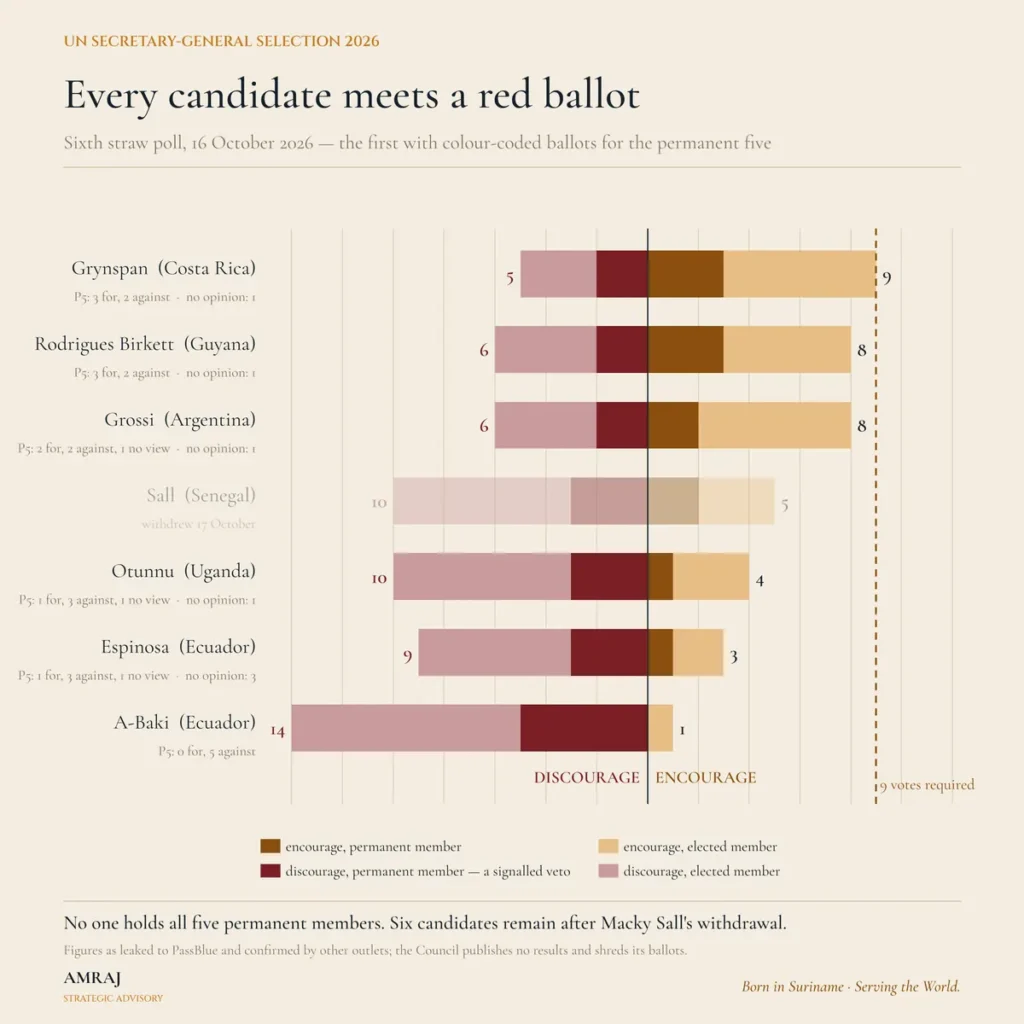
The sixth straw poll, on 16 October, was the first to use colour-coded ballots for the five permanent members. The result is unambiguous in one respect: every candidate drew at least one permanent-member “discourage”. Rebeca Grynspan (Costa Rica) again led on “encourage” votes (9), but carried five “discourage”, two of them from the P5. Rafael Grossi (Argentina) and Carolyn Rodrigues-Birkett (Guyana), each on 8 / 6, also drew two red “discourage” ballots apiece. The P5 reportedly rejected Ivonne A-Baki roundly — all five permanent members discouraged her — and Olara Otunnu received 4 / 10 / 1.
Macky Sall withdrew on 17 October, observing that the polls point to a candidate from Latin America and the Caribbean, possibly a woman. Six candidates remain: Grynspan, Rodrigues-Birkett, Grossi, A-Baki, María Fernanda Espinosa (nominated by Antigua and Barbuda) and Otunnu. Panama endorsed Grossi on 16 October; CELAC wrote on 13 October that “the time has come” for a national of the region.
| Candidate | Encourage (of which P5) | Discourage (of which P5) | No opinion | Status |
|---|---|---|---|---|
| Rebeca Grynspan (Costa Rica) | 9 (3) | 5 (2) | 1 | In the race |
| Carolyn Rodrigues-Birkett (Guyana) | 8 (3) | 6 (2) | 1 | In the race |
| Rafael Grossi (Argentina) | 8 (2) | 6 (2) | 1 | In the race |
| Macky Sall (Senegal) | 5 (2) | 10 (3) | 0 | Withdrew 17 October |
| Olara Otunnu (Uganda) | 4 (1) | 10 (3) | 1 | In the race |
| María Fernanda Espinosa (Ecuador) | 3 (1) | 9 (3) | 3 | In the race |
| Ivonne A-Baki (Ecuador) | 1 (0) | 14 (5) | 0 | In the race |
Why it matters
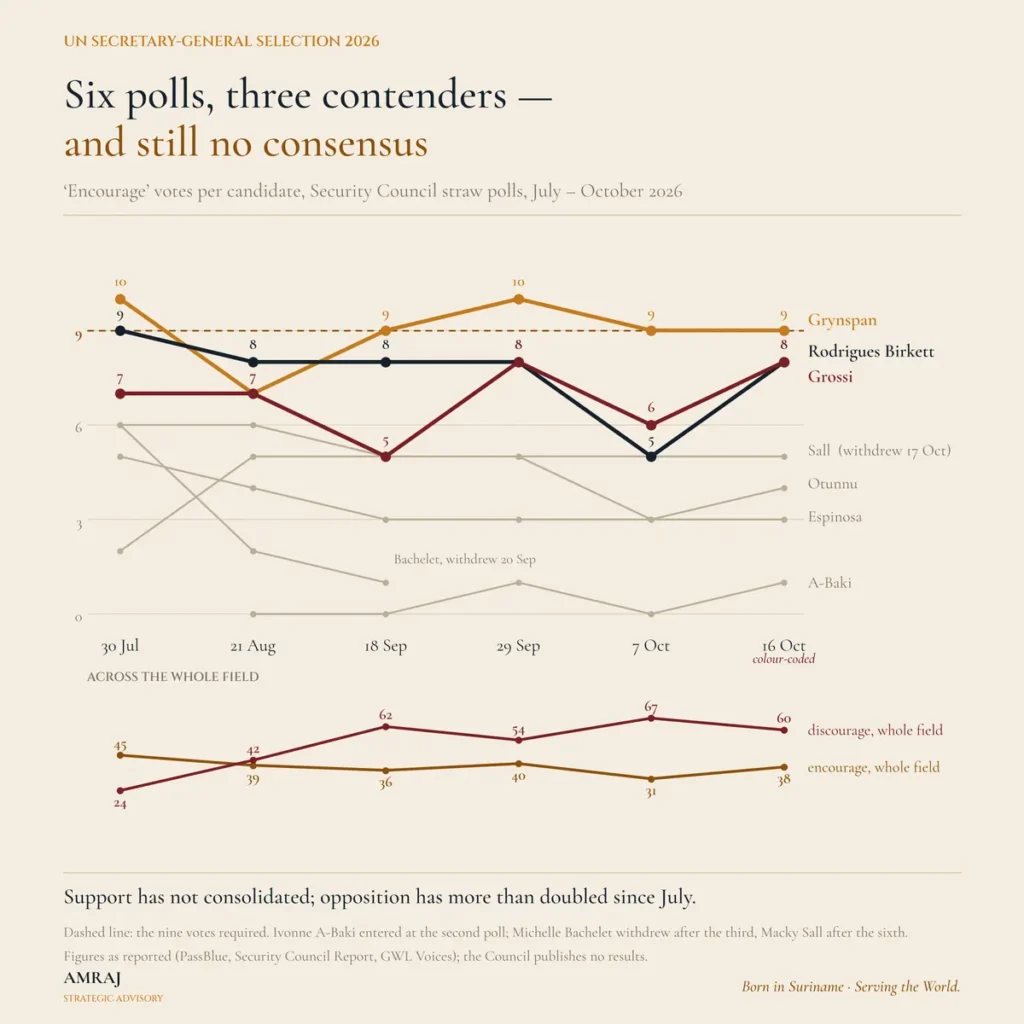
Rodrigues-Birkett’s trajectory is instructive. First in August with 8 “encourage”, she fell to 5 / 9 in the fifth poll before recovering to 8 / 6 in the sixth — still with two permanent-member objections, reportedly including the United States, linked to her statements on Gaza. It is a lesson every small-state diplomat learns early: in this Council, breadth of goodwill among the elected ten counts for little if a single red ballot stands in the way.
With António Guterres’s term ending on 31 December, and no precedent for a deadlock at this stage, a compromise acceptable to all five permanent members — or a late entrant — is now a real possibility. History offers a reminder: in 1991, the first year with coloured ballots, the eventual winner emerged only once the vetoes were visible. For CARICOM, the strategic task is to keep the regional claim intact even if its own candidate does not prevail. A region that lets its claim fragment into rival national bids may win the argument and still lose the post.
| Candidate | 30 Jul | 21 Aug | 18 Sep | 29 Sep | 7 Oct | 16 Oct |
|---|---|---|---|---|---|---|
| Grynspan | 10 / 1 | 7 / 4 | 9 / 5 | 10 / 3 | 9 / 6 | 9 / 5 |
| Rodrigues-Birkett | 9 / 2 | 8 / 3 | 8 / 6 | 8 / 6 | 5 / 9 | 8 / 6 |
| Grossi | 7 / 2 | 7 / 6 | 5 / 8 | 8 / 7 | 6 / 7 | 8 / 6 |
| Sall | 6 / 7 | 6 / 7 | 5 / 9 | 5 / 9 | 5 / 10 | 5 / 10 (withdrew) |
| Otunnu | 2 / 5 | 5 / 5 | 5 / 7 | 5 / 8 | 3 / 12 | 4 / 10 |
| Espinosa | 5 / 2 | 4 / 3 | 3 / 6 | 3 / 10 | 3 / 9 | 3 / 9 |
| A-Baki | — | 0 / 8 | 0 / 10 | 1 / 11 | 0 / 14 | 1 / 14 |
| Bachelet | 6 / 5 | 2 / 6 | 1 / 11 | Withdrew 20 September | ||
| Whole field | 45 / 24 | 39 / 42 | 36 / 62 | 40 / 54 | 31 / 67 | 38 / 60 |
21 September: the third straw poll
On 18 September the Security Council held its third informal straw poll. The reported figures, encourage / discourage:
Rebeca Grynspan (Costa Rica) – 9 / 5;
Carolyn Rodrigues-Birkett (Guyana) – 8 / 6;
Olara Otunnu (Uganda) – 5 / 7;
Rafael Mariano Grossi (Argentina) – 5 / 8;
Macky Sall (Senegal) – 5 / 9;
María Fernanda Espinosa Garcés (Ecuador) – 3 / 6;
Michelle Bachelet (Chile) – 1 / 11
Nine is the number a candidate needs. It is also only the first of two gates. Colum Lynch of Devex, who published the results, notes that it remains unclear whether Ms Grynspan can survive a veto. Ian Richards puts it from the other side: nobody outside that chamber knows which discouragements came from a permanent member. (Since 16 October, we do.)
One figure has gone almost unnoticed. Across the field, encouragements have fallen 45 → 39 → 36. Discouragements have risen 24 → 42 → 62. The Council is hardening against candidates faster than it is consolidating behind any one of them. (Six polls in, the series reads 45 → 39 → 36 → 40 → 31 → 38 and 24 → 42 → 62 → 54 → 67 → 60.)
So let us not be carried away by a leading number. Processes that behave this way tend to end with a name that was not on the list when the voting began.
A caution for all of us following this: none of these figures is official. The Council publishes nothing and shreds its ballots after every round.
Something this consequential deserves rather more attention than it is receiving. And I would be interested to know what Suriname’s administration has formulated as its intentions going into this round of behind-the-scenes lobbying.
Correction: the original version of this piece stated that no Secretary-General had come from Latin America or the Caribbean. Javier Pérez de Cuéllar of Peru served from 1982 to 1991.
Sources: Anadolu, 1 Nov 2026; Turkish Minute / AFP, 31 Oct 2026; The National, 3 Nov 2026; The National, 30 Oct 2026; Jewish Insider, 2 Nov 2026; Al-Monitor, Nov 2026; ANTARA / Xinhua; AP via The National Herald; Greek City Times / AMNA, 3 Nov 2026; PassBlue, 21 Oct 2026; The Media Line, 22 Oct 2026; AEI, 19 Oct 2026; Geneva Solutions / Le Temps; Kaag on Zomergasten, Aug 2026; Security Council Report, 16 Oct 2026; PassBlue, 16–17 Oct 2026; Newscord, 16 Oct 2026; Capital FM, 17–18 Oct 2026; CELAC declaration; earlier rounds: PassBlue, Security Council Report, GWL Voices, 1 for 8 Billion.